Jonathan’s Expulsion from the Flock
Jonathan Livingston SeagullJonathan’s Expulsion from the Flock is the decisive break between Jonathan Livingston Seagull and the community whose assumptions he challenges: after his flight breakthrough, the Council brands him shameful and banishes him to the Far Cliffs. The sentence enforces the Flock’s traditions, but it cannot extinguish his purpose. Alone, he develops the flying that the Flock has dismissed, and the experience of exile becomes part of a longer movement from private discovery to teaching and a direct challenge to the prohibition against outcasts returning.
Causes and the Council’s Sentence
The conflict begins with a difference in what flight is for. Most gulls learn only enough flying to travel from shore to food and back; eating, not flying, matters most to them. Jonathan reverses that priority. Flight itself is his purpose, and his experiments take him beyond the accepted function of gull flight. The Council’s response treats this pursuit not as a new skill but as a threat to the order that defines respectable gull behavior.
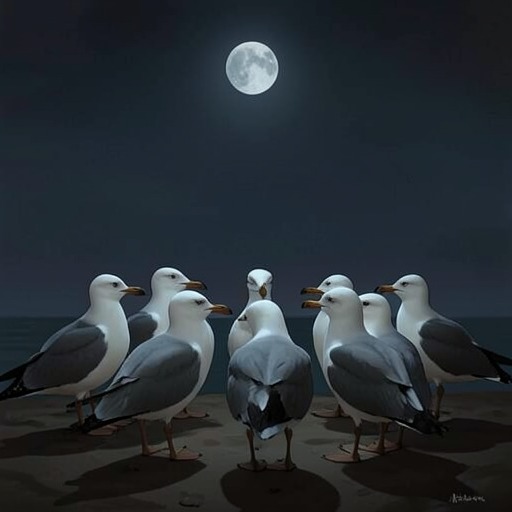
After Jonathan lands at the Council Gathering, the Elder calls him to the center. The summons might signal great honor or great shame, and Jonathan initially hopes that the Flock has recognized his breakthrough. Instead, the Elder names the occasion as a public shaming. The judgment cites Jonathan’s “reckless irresponsibility” and his violation of the “dignity and tradition of the Gull Family.” The Council thus frames experimentation as misconduct: the issue is not simply whether Jonathan can fly, but whether he may pursue a purpose outside the Flock’s inherited priorities.
The sentence gives that judgment a concrete force. To be centered for shame means expulsion from gull society and a solitary life on the Far Cliffs. The Elder warns that irresponsibility does not pay and presents life as unknowable except for the imperative to eat and stay alive as long as possible. Against Jonathan’s pursuit of learning and freedom, the Council asserts survival as the only safe, legitimate purpose. Its ruling turns a dispute over flight into a choice between the community’s received limits and an individual’s search for meaning.
Protest and Rejection
Jonathan does not accept the Council’s account in silence. He appeals to his fellow gulls, calling them brothers and arguing that a gull who finds and follows a higher purpose is acting responsibly. For a thousand years, he says, the Flock has scrabbled after fish heads; now there could be a reason to live beyond that routine—to learn, discover, and be free. His appeal is an offer to share what he has found, not a bid for leadership or honors.
The appeal receives no answer. The Flock remains as immovable as stone, and the gulls pronounce that the Brotherhood is broken. In a single coordinated gesture, they close their ears and turn their backs. The scene makes exclusion more than a formal decision: the community refuses even to hear the possibility Jonathan represents. His expulsion is therefore both a change in status and a deliberate social severing, enacted through collective words and bodies.
Exile and Its Consequences
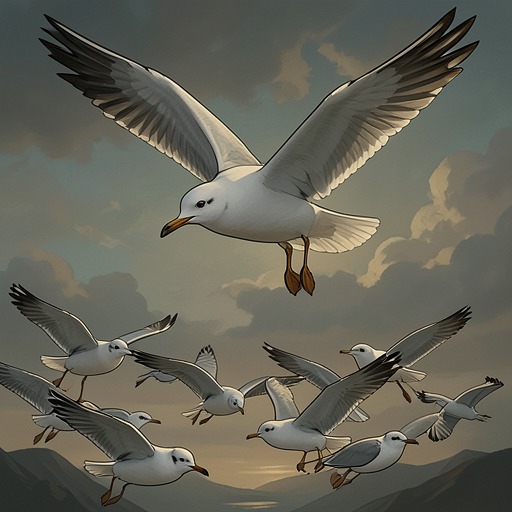
Jonathan spends the rest of his days alone, but the loss of the Flock does not end his development as a flier. He goes beyond the Far Cliffs and continues learning. A high-speed, streamlined dive lets him find rare fish schooling ten feet below the ocean’s surface, freeing him from dependence on fishing boats and stale bread. He learns to sleep in the air, following the offshore wind at night and covering a hundred miles between sunset and sunrise.
His experiments also carry him through conditions in which other gulls remain grounded. He flies through heavy sea fog and climbs into clear skies above it, then rides high winds inland to feed on delicate insects. These practical discoveries show how far his pursuit has moved beyond the Council’s narrow equation of life with ordinary feeding: his skill supplies food, but it also opens forms of movement and experience unavailable to the gulls who refuse to experiment. Jonathan gains alone what he had once hoped the Flock might gain together, and he does not regret the cost of exile.
The narrative also connects this development to a change in how Jonathan understands a gull’s life. He discovers that boredom, fear, and anger are reasons that a gull’s life is short; with those removed from his thought, he lives a long, fine life. Exile is not presented as an easy reward or as a reversal of the Council’s decree. It leaves him isolated from the society he wanted to teach, even as it gives him the conditions in which to practice and learn without its restrictions.
From the Outcast to the Teacher
Jonathan’s later understanding of exile does not remain confined to the Far Cliffs. In a new stage of learning, he recognizes that the school he has completed is one among others and that it is time to go home. The departure reframes his history: the outcast who once wanted to share his discovery with the Flock can now return with further knowledge. His education has made flight a discipline of understanding as well as a physical skill. When he asks whether there is a place called heaven, his teacher explains that heaven is not a place or a time but being perfect, and that perfect speed is being there. Those teachings broaden the meaning of the original conflict: the Council had treated established survival as life’s limit, while Jonathan’s path has led toward a conception of perfection without limits.
After the disappearance of his teacher, Jonathan repeatedly thinks about Earth and wonders whether another gull there might be struggling to exceed those same limits. He imagines one who has been made an outcast for speaking against the Flock, and the possibility strengthens his desire to return. His growing interest in kindness and love accompanies this decision. Although he has known loneliness, he understands himself as born to instruct; his way of demonstrating love is to give another gull the chance to see the truth for itself.
Jonathan’s return makes the unresolved force of his expulsion visible. His students hesitate because the Law of the Flock says that an outcast never returns, a rule unbroken for ten thousand years. Jonathan flies toward the home grounds anyway, and the others follow in an eight-gull formation. The return is not merely a homecoming: it crosses the very boundary the Council had imposed on him. When the Elder’s word reaches the Flock, the command is to ignore the outcasts; a gull who speaks to one becomes an outcast, and even looking at one breaks the Law. The old exclusion is renewed, but Jonathan and his students are present in public, demonstrating the flight and freedom that the Council’s rule was meant to keep outside the community.
The Expulsion’s Lasting Meaning
The episode establishes a conflict between tradition’s authority and a principle tested through practice. The Flock’s prohibition presents itself as law, while Jonathan’s experience supplies an alternative standard: a rule deserves obedience only if it leads to freedom. When a voice from the listening gulls asks whether even the Law of the Flock must be set aside, Jonathan answers that the only true law is the one that leads to freedom. His argument reaches back to the original expulsion, when the Council used the language of responsibility to defend the limits Jonathan had challenged.
The expulsion also gives the story’s return and teaching their stakes. Jonathan first wanted the Flock to share in the freedom and excellence he believed flight could open; the Council answered by cutting him off. Exile lets him pursue that possibility alone, but it does not erase his desire to pass it on. His later return turns the sentence into a boundary to be challenged, and his teaching makes the conflict larger than the punishment of one gull. The Council can declare the Brotherhood broken and command its members not to look, yet the story’s movement from solitary practice to public instruction tests whether inherited rules can contain what another gull has learned to become.